
Speech Therapy for Children

Articulation versus Phonological Disorders

Articulation Disorder: A physical, motoric difficulty making specific speech sounds.

Phonological Disorder: A language-based issue regarding the rules of using sounds and organizing sounds into patterns to produce words. Even if the child is physically capable of producing the sound(s) they are not using the sound when needed. There are 24-phonological processes. 12 of those are considered Core Phonological Processes.

Articulation

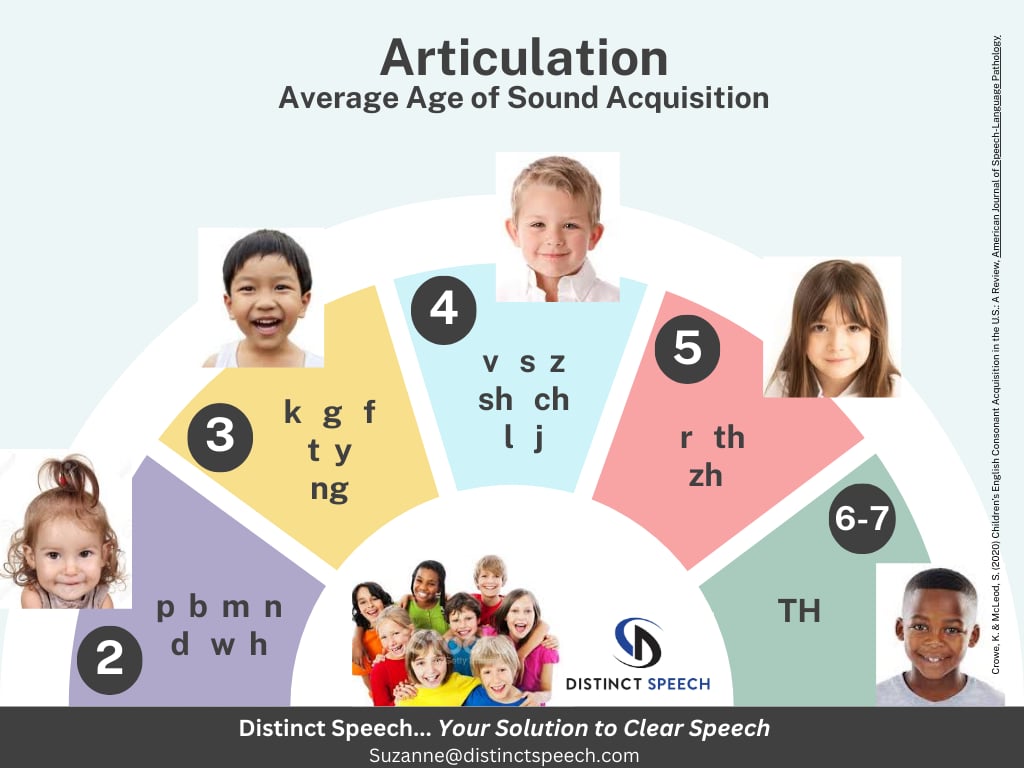
An articulation disorder occurs when a child has physical, motoric difficulty producing specific speech sounds. The child is still learning how to coordinate their lips, tongue, teeth, and jaw to produce the sounds. Sound acquisition progresses through general ages and stages.

Information for the Distinct Speech Sound Acquisition chart is from the American Journal of Speech-Language Pathology (2020). Crowe, K.

& McLeod, S. Children’s English Consonant Acquisition in the United States: A Review.
The acronym SODA can be used for the 4 types of articulation errors.

  • S = Substitution: Replacing one sound with another; such as saying ”bed” for ”red”.
  • O = Omission: Leaving out a needed sound; such as saying “cu-cake” for “cupcake.”
  • D = Distortion: Producing a recognizable sound that lacks clarity; e.g., a frontal or lateral “lisp” of the /s/
    sound.
  • A = Addition: Adding a sound or syllable to a word; such as saying “puh-lay” for “play.”

Potential Causes of an Articulation Disorder

  • Physical & Structural Differences: Issues like a cleft lip, cleft palate, or dental malocclusions (severe
    overbite/underbite).
  • Hearing Loss: Speech is learned by listening and mimicking and ear infections or hearing impairments can
    cause delays in speech sound development.
  • Neurological Conditions: Conditions like cerebral palsy, traumatic brain injury, or childhood apraxia of
    speech may cause an articulation disorder.
  • Oral-Motor Delays: Weakness or poor coordination in the muscles of the mouth and/or face.

Phonological Processing

Phonological processes are a way for young children to simplify the way they talk. While learning to talk, children make speech easier for themselves by producing simpler sounds instead of making the more effortful or difficult sound that the word needs. For example, a child may say “top” for “stop” or “wed” for “red”. Phonological processes are a normal part of early childhood development and should naturally be resolved during a child’s early years. However, for some children, incorrectly using phonological processes becomes routine and continues beyond the average age of elimination. For example, a child may be capable of correctly producing the /k/ sound, but when they need to say “cookie” the child incorrectly says “tootie.” There are 24 phonological processes. The following chart highlights 7 of the problematic phonological processes.

The Twelve Core Phonological Processes and the age at which they should be eliminated are as follows:

  • SYLLABLE REDUCTION occurs when a child omits/leaves out a syllable from a word with more than one syllable. Examples of SYLLABLE REDUCTION: incorrectly say “ehfunt” instead of “elephant,” incorrectly say “sketti” for “spaghetti,” or incorrectly say “vegbul” for “vegetable.” Although common in the early stages of childhood, SYLLABLE REDUCTION is expected to be resolved by the age of 2-yrs-6-mos.
  • FINAL CONSONANT DELETION occurs when a child omits the final consonant sound in words. Examples: incorrectly say “cu” for “cup,” or say “fro” for “frog,” or incorrectly say “schoo” for “school.” Although common in the early stages of childhood, FINAL CONSONANT DELETION is expected to be resolved by the age of 3 years.
  • VELAR FRONTING is replacing back-of-the-mouth sounds like /k/ and /g/ with front-of-the-mouth sounds like /t/ and /d/. Examples of VELAR FRONTING: incorrectly say ”tup” for ”cup” or ”dot” for ”got” or incorrectly say “tootie” for “cookie.” While common in the early stages of childhood, VELAR FRONTING is expected to be resolved by the age of 3 years.
  • PALATAL FRONTING occurs when palatal sounds (sounds made with the body of the tongue raised to hard palate, mid-roof region of the mouth) such as /sh, zh, ch, j) are replaced by sounds made at the front of the mouth, typically the alveolar sounds /s/, /z/, /t/, and /d/. Examples of PALATAL FRONTING: incorrectly say “seep” for “sheep,” or say “tair” for “chair,” or incorrectly say “duice” for “juice.” While common in the early stages of childhood, PALATAL FRONTING is expected to be resolved by the age of 3 years.
  • STOPPING occurs when a child uses an easier to produce “stop sound” such as /p, b, t, d, k, g/ instead of the needed fricative or affricate sound /f, v, th, s, z, sh, ch, j/ that requires more effort and airflow. Essentially, a child is simplifying their speech but speaking incorrectly. Examples of STOPPING: incorrectly say “pish” for “fish,” or say “tum” for “thumb,” or incorrectly say “bacoom” for “vacuum,” or incorrectly say “dump” for “jump.” Although common in the early stages of childhood, STOPPING is expected to be resolved by the age of 3-yrs-6-mos.
  • INITIAL VOICING (aka Prevocalic Voicing) occurs when a child needs to use a voiceless (no vocal fold vibration) consonant such as /p, t, k, f, s/ at the beginning of a word or syllable, but substitutes the needed sound with a voiced (vocal folds vibrate) sound such as /b, d, g, v, z/. Examples of INITIAL VOICING: incorrectly say “gup” for “cup,” or say “zilly” for “silly,” or say “gat” for “cat,” or incorrectly say “doy” instead of “toy.” Although common in the early stages of childhood, INITIAL VOICING (Prevocalic Voicing) is expected to be resolved by the age of 3-yrs-6-mos.
  • CLUSTER SIMPLIFICATION occurs when a child simplifies a word by omitting, substituting, or changing one or more consonants in a sound cluster (blend). Examples of CLUSTER SIMPLIFICATION: incorrectly say “poon” for “spoon,” or say “tuck” for “truck,” or say “boo” for “blue,” or say “pate” for “plate.” Although common in early childhood, CLUSTER SIMPLIFICATION is expected to be resolved by the age of 4 years.
  • DEAFFRICATION is a sound substitution pattern that occurs when a child replaces the sounds “ch” and ‘j’ with easier to produce sounds such as /sh, s, z, t, d/. Examples of DEAFFRICATION: incorrectly say “ship” for “chip,” or say “sheese” for “cheese,” or incorrectly say “dump” for “jump.” DEAFFRICATION is expected to be resolved by the age of 4 years.
  • FINAL DEVOICING occurs at the end of a word of syllable. It is when a child needs to use a voiced sound such as /b, d, g, v, z, or ch/ but incorrectly uses a voiceless sound like /p, t, k, f , s, or sh/. Examples of FINAL DEVOICING: incorrectly say “bat” for “bad,” or say “cash” instead of “catch,” or say “pick” for “pig.” Although common in the early stages of childhood, FINAL DEVOICING is expected to be resolved by the age of 4 years.
  • STRIDENCY DELETION occurs when a child simplifies or deletes strident sounds such as /s, z, sh, ch, j/ when speaking and replaces these stridents with non-strident sounds. Examples of STRIDENCY DELETION: incorrectly say “teez” for “cheese,” or say “doo” for “zoo,” or incorrectly say “tip” for “ship.” Although common in the early stages of childhood, STRIDENCY DELETION is expected to be resolved by the age of 4-yrs-6-mos.
  • VOCALIZATION (aka Vowelization) is the substitution of a vowel-like sound or diphthong for a liquid sound /l/ or /r/ sound. Examples of VOCALIZATION: incorrectly say “bayuhw” for “bear;” incorrectly say “tabehw” for “table;” say “puzzehw” for “puzzle;” say “brothehw” for “brother.” Although common in early childhood, VOCALIZATION is expected to be resolved by the age of 6-to-7 years.
  • GLIDING is a form of sound substitution. GLIDING occurs when a child uses the sounds /w/ or /y/ when they need to use the /r/ or /l/ sound. Examples of GLIDING: incorrectly say “wabbit” for “rabbit;” say “yeyo” for “yellow;” or say “wed” for “red.” Although common in early childhood, GLIDING is expected to be resolved by the age of 6-to-7 years.

    At Distinct Speech we work with children, their parents, and caregivers to improve a child’s speech delays or disorders. Articulation difficulties involve problems producing speech sounds. Phonological processing difficulties have to do with learning the rules and patterns for how to use sounds and sound clusters to make words. Phonological processing can negatively impact a child’s reading and spelling skills. The 12 Primary Phonological Processes are CLUSTER SIMPLIFICATION, FINAL CONSONANT DELETION, SYLLABLE REDUCTION, STOPPING, FRONTING, GLIDING, VOCALIZATION, DEAFFRICATION, STRIDENCY DELETION, FINAL DEVOICING, and INITIAL VOICING. Check out and subscribe to our YouTube channel @distinctspeech for examples and practice videos. A few examples include:
  • difficulty producing a sound such as “r” the child may say “wed” instead of “red”
  • sound distortions such as producing a slushy, sloppy “s” as with a lisp
  • leaving out sounds such as saying “ca, cu, coo” instead of “cat, cup, cool”
  • substituting one sound for another such as saying “tat, tup, tool” instead of “cat, cup, cool”
  • adding syllables or leaving syllables out such as saying “elephalant” or saying “ephant” instead of “elephant” or saying “sketti” instead of “spaghetti”
distinctspeech.comdistinctspeech.com

Causes of a Speech Delay or Disorder

Speech delays and disorders may be caused by:

  • premature birth
  • developmental delays and disorders
  • ASD / autism
  • ADHD / ADD
  • Down’s Syndrome
  • environmental deprivation
  • intellectual disabilities
  • cerebral palsy
  • muscular dystrophy
  • brain injury
  • hearing loss
  • neurodiversity

IMPACT

Without treatment, research has found that a speech delay or disorder can:

  • progressively worsen 
  • impede your child’s success in school
  • slow your child’s ability to learn
  • hinder communication with friends and family
  • compromise your child’s self-confidence
  • sadly, a speech problem can make a child more susceptible to bullying

A licensed and certified Speech Pathologist with Distinct Speech will evaluate and provide individualized training tailored to your child’s specific needs.

From Our Articulation Families

“As a family therapist for many years, I have witnessed the bullying that can result from indistinct speech. When my own Grandson was struggling with speech that sounded much younger than his age I witnessed a transformation in a matter of months with Distinct Speech. He became confident and more comfortable with his peers as his speech sounded more age appropriate. Our family is so thankful for this outcome. Thank you Distinct Speech.”

Judith M. Wilkins, Ph.D.
Family Therapist

“My son was 10 when he began working with Distinct Speech. His progress was steady, timely, and permanent. He accomplished his speech goals in six months. By the time he was in middle school he was participating in the theater program. His work with Distinct Speech opened countless opportunities for him that would not have been available otherwise.”

Katrina M. Jansky
Associate Professor, Texas State University

“I’m so glad we found Distinct Speech. In just 5 months our son mastered the R sound. He’s worked on that for years, but not until we found Distinct Speech did we find therapy that worked for Janson. He goes to middle school next yeaR, and we’Re Really pRoud that he can say his Rs. Thank you Distinct Speech.”

Marla D., Mother
Janson, age 10, Dallas, Texas

“La’Launa was and forever will be touched by your compassion and abilities. You are a great example of an exceptional human being and we are blessed to have met you.”

Tinisha M., Mother
La’Launa, age 5, Oak Park, Illinois

Stuttering

If You Stutter, You’re in Good Company

If you stutter, you’re in good company. Throughout history, many famous people have been stutterers. Such as Kindrick Lamar, Shaquille O’Neal, Steve Harvey, and former President Joe Biden just to name a few. It is estimated 1% of the global population, or roughly 80 million people, live with a long-term stutter. 5% to 10% of young children go through a stage of stuttering. Most experience spontaneous recovery meaning the stutter resolves without therapy. If a child continues to stutter beyond age 4, the risk of becoming a long-term stutterer increases. Stuttering is more common in boys than girls. Stuttering is not caused by anxiety, emotional trauma, or poor parenting. Instead, experts recognize stuttering as a complex neurological difference. Stuttering may stem from a combination of genetics, brain development, and speech processing limitations that can cause a breakdown in the oral flow of speech. Some consider stuttering neurodiversity.

At Distinct Speech we use an effective system to address “Bumpy Speech” (dysfluency). There are three effective therapy methods, Fluency Shaping, Stutter Modification, and Avoidance Reduction. Based on a child’s needs we use one or a combination of these methods.

  • Fluency Shaping Methods: Easy Onset for Smooth Speech, Continuous Phonation, Diaphragmatic Breathing
  • Stutter Modification Method: Cancellations, Pull Outs, Ease Outs, Preparatory Sets
  • Avoidance Reduction Therapy: Confidence Building, use of “Brave Speech” (not just Smooth Speech)

We offer parent and caregiver counseling. Plus, we have the Video Gym and many Resources for practice between therapy sessions. Therapy is on-line, one-on-one, at your convenience and always conducted by a licensed and certified Speech Pathologist.

Stuttering and articulation therapy are not only for children, Some adults sign up for stuttering and articulation therapy with Distinct Speech to say “Goodbye” to a speech issue they’ve had since childhood.

distinctspeech.com child holding table
distinctspeech.com

From Our Articulation Families

“As a family therapist for many years, I have witnessed the bullying that can result from indistinct speech. When my own Grandson was struggling with speech that sounded much younger than his age I witnessed a transformation in a matter of months with Distinct Speech. He became confident and more comfortable with his peers as his speech sounded more age appropriate. Our family is so thankful for this outcome. Thank you Distinct Speech.”

Judith M. Wilkins, Ph.D.
Family Therapist

“My son was 10 when he began working with Distinct Speech. His progress was steady, timely, and permanent. He accomplished his speech goals in six months. By the time he was in middle school he was participating in the theater program. His work with Distinct Speech opened countless opportunities for him that would not have been available otherwise.”

Katrina M. Jansky
Associate Professor, Texas State University

“I’m so glad we found Distinct Speech. In just 5 months our son mastered the R sound. He’s worked on that for years, but not until we found Distinct Speech did we find therapy that worked for Janson. He goes to middle school next yeaR, and we’Re Really pRoud that he can say his Rs. Thank you Distinct Speech.”

Marla D., Mother
Janson, age 10, Dallas, Texas

“La’Launa was and forever will be touched by your compassion and abilities. You are a great example of an exceptional human being and we are blessed to have met you.”

Tinisha M., Mother
La’Launa, age 5, Oak Park, Illinois